A book by Kuunal Verma
If you stepped away for ninety days, what would break?
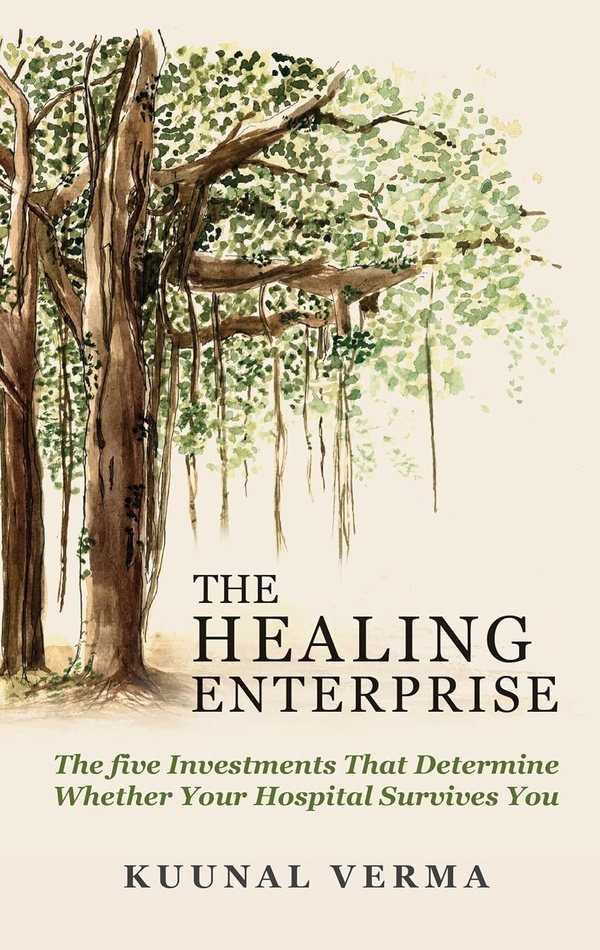
The Healing Enterprise
The Five Investments That Determine Whether Your Hospital Survives You
A book for hospital founders, trustees and chief executives about the five disciplines that decide whether an institution survives the person who built it.
The continuity question
Building a hospital and building an institution are not the same work.
It is eleven-thirty at night. The founder of an Indian hospital sits alone in his office, staring at a balance sheet he cannot fully read. The wards two floors below are at 88% occupancy. The collections report says the institution is dying.
Most founders of Indian hospitals were trained to heal, not to run institutions. They became excellent at medicine, built reputations patients trust, and filled their wards. Many never learned the other disciplines a hospital needs to survive them.
The result is often a hospital that works because one person is present for every important decision. It is admired, busy and fragile.
The Healing Enterprise treats this as a structural problem rather than a personal failing. It asks what a founder must build, deliberately and early, so that the institution can carry on when they step back.
What a hospital has, and what an institution needs
- Clinical excellence
- Organisational capability
- A founder’s personal competence
- An institution that does not depend on it
- Full wards and busy billing counters
- Revenue that is actually collected
- Good intentions
- Systems that work on an ordinary Tuesday
- Personal authority
- Accountable leadership
- Success today
- Continuity tomorrow
The framework · Panch Nivesh
Five investments that hold an institution up.
The book organises the disciplines of an enduring hospital as investments: a founder makes them over years, and they pay off when the founder is no longer in the room.
-
Vidyā
Knowledge · the truth about the numbers
“The investment in clear-eyed truth-telling about your numbers.”
- The question
- Can you read your own balance sheet, and would anyone tell you if it were getting worse?
- Why it matters
- Occupancy can rise while an institution weakens. Billing is not revenue.
-
Viveka
Judgement · counsel that can challenge you
“The investment in the wisdom of those who can challenge you.”
- The question
- Who in your institution can tell you that you are wrong, and be heard?
- Why it matters
- A founder’s authority can quietly silence the people best placed to see what the founder cannot.
-
Vittam
Capital · financial discipline
“The investment in financial discipline beyond clinical excellence.”
- The question
- Is your hospital financially sound, or only clinically excellent and busy?
- Why it matters
- A clinical reputation fills wards. On its own, it does not fund the next decade.
-
Vibandha
Structure · systems that outlast you
“The investment in systems that survive your absence.”
- The question
- If you stepped away for ninety days, which decisions would simply stop?
- Why it matters
- Succession is the real test of leadership, and it is decided long before the founder leaves.
-
Vātsalya
Stewardship · the person you remain
“The investment in the human being you must remain through the building.”
- The question
- Has the institution you built begun to consume the builder?
- Why it matters
- The founder’s own character and wellbeing shape the institution. They are not a private matter.
Quoted lines are from the book’s published description.
What healthcare leaders are saying
Kuunal Verma reminds us that the true measure of a healthcare institution is not merely its scale or success, but its ability to endure, evolve, and serve with purpose.
The five investments defined in this book are management disciplines which have never been defined in this manner. I would strongly recommend this to every hospital owner.
Inside the book
Not a book about how to start a hospital. A book about how to keep one alive.
Twelve chapters, named for figures from the Mahabharata
Among them: Ekalavya, Drona, Karna, Bhishma and Yudhishthira.
The book draws on an Indian intellectual tradition that secular management literature has largely missed, and uses it to examine problems hospital leaders face today.
-
Composite case studies
Drawn from twenty-eight years of work with hospitals across India and four continents, from Tier-2 cities in Uttar Pradesh to charitable trusts in Tamil Nadu. Each chapter pairs a hard financial reality with a story.
-
Hard-won frameworks
Management frameworks that turn the five investments from ancient wisdom into a modern operating discipline for founders, boards and leadership teams.
-
The Provocations
Each chapter closes with diagnostic questions designed to be carried into the next trustee meeting, the next clinical-administrative review, the next conversation with the founder you serve.
-
The Charioteer’s Last Question
The book closes with the question every leader who has built something must eventually answer.
Want to judge the writing before you buy? Google Play offers a free sample of the ebook.
Read the free sampleWho it is written for
For the people who carry a hospital.
The doctor-founder facing succession, who built a hospital and now wants it to become an institution.
The founder who senses that too much still depends on them, and suspects the institution has begun to consume the builder.
The trustee stewarding a charitable institution, responsible for its mission and its sustainability.
The CMD or CEO running operations the founder no longer fully understands, and building the systems and discipline to match.
The successor who must learn to lead an institution, not just inherit it.
Not for: readers looking for a guide to setting up a new hospital. The book is about sustaining one that already exists.
Choose your edition
The Healing Enterprise
The Five Investments That Determine Whether Your Hospital Survives You · Kuunal Verma
- Paperback on Pothi.com — ₹649 plus shipping, ships within India only
- Kindle ebook on Amazon.in
- Ebook on Google Play Books, with a free sample
You will complete your purchase on the retailer’s website. Prices, shipping and availability are set by each retailer and may change; the paperback price was last checked on .
Before you buy
Questions, answered plainly.
What is the book about?
It is about why capable hospitals fail to outlive their founders, and the disciplines that prevent it. Kuunal Verma argues that brilliant clinicians who built remarkable hospitals often never learn those disciplines, and sets them out as a framework called Panch Nivesh: the Five Investments.
Who is it written for?
Doctor-founders facing succession, trustees of charitable institutions, CMDs and CEOs, senior hospital administrators, and anyone who suspects the institution they built has begun to consume the builder.
Is it about starting a hospital or sustaining one?
Sustaining one. In the book’s own words, it is not a book about how to start a hospital; it is a book about how to keep one alive.
What are the five investments?
- Vidyā: clear-eyed truth-telling about your numbers.
- Viveka: the wisdom of those who can challenge you.
- Vittam: financial discipline beyond clinical excellence.
- Vibandha: systems that survive your absence.
- Vātsalya: the human being you must remain through the building.
Which formats are available?
A paperback from Pothi.com, a Kindle ebook from Amazon.in and an ebook from Google Play Books.
Where can I order the paperback?
From Pothi.com. When last checked it was listed at ₹649 plus shipping, 309 pages, dispatched in 5–7 business days.
Where can I buy or sample the ebook?
On Amazon.in for Kindle or on Google Play Books, which offers a free sample. Current ebook prices are shown on each retailer’s page.
Are there shipping or availability restrictions?
The Pothi.com paperback ships within India only, and shipping is charged separately. Ebook availability depends on your Amazon or Google Play country store. Readers outside India should check the ebook listings.
The Charioteer’s Last Question
Every founder eventually steps away. What will still be standing?
The book ends with the question every leader who has built something must eventually answer. It is better faced while there is still time to act on the answer.